
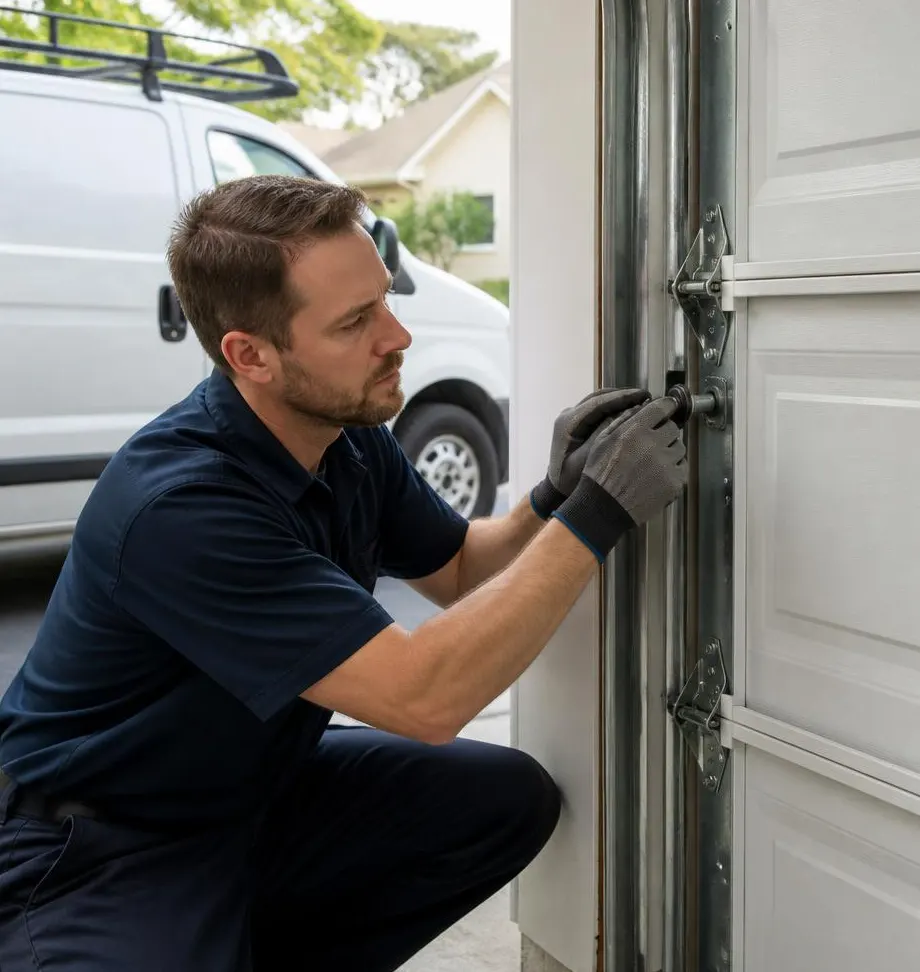
What Skipping This Costs You
A garage door that goes a full season without attention doesn't fail quietly. It fails loudly, usually on a humid afternoon when you're already late, with a spring that's been rusting since summer or rollers that finally seized after months of grinding against dry metal. In this part of Florida, moisture does the damage slowly: a hinge that looks fine in August can be frozen solid by the time cooler, drier air rolls in. By the time you notice, you're not looking at a twenty-minute fix anymore — you're looking at a stuck door, a stripped opener gear, or a spring that snaps mid-cycle. A seasonal check doesn't prevent every problem, but it catches the ones that are still cheap.
Tools You'll Need
- Flashlight
- Work gloves
- A socket wrench or adjustable wrench
- Silicone-based garage door lubricant (not WD-40 or household oil — they attract dust and grit, which is worse in humid, dusty conditions)
- A rag or paper towels
- A step stool, if your track runs high
The 20-Minute Routine
- Look before you touch. With the door closed, walk the full length of both tracks with the flashlight. You're checking for rust spots, bent sections, gaps where the track pulls away from the wall, and any buildup of grime or dead insects in the track channel. Wipe out loose debris with the rag.
- Check the hardware. Go along the track brackets, hinges, and roller brackets with the wrench and snug up anything that's loose. Vibration from regular use works bolts loose over time, and a loose bracket is often the first sign of a track that's starting to pull out of alignment.
- Inspect the rollers. Look at each roller for cracking, flat spots, or visible wear. Nylon rollers should spin freely by hand; if one is stiff, chipped, or wobbling on its stem, note it — that's a wear item, not something to force.
- Lubricate moving parts. Apply the silicone lubricant to the hinges, roller stems (not the roller wheel itself), and the torsion spring. A light coat is enough — it's not meant to drip. This single step does more to prevent the grinding, squealing, and stiff operation that humidity causes than almost anything else on this list.
- Check the weatherstripping. Run a hand along the bottom seal and side weatherstripping. Humidity causes vinyl seals to swell, crack, or pull away from the frame. If daylight shows through gaps, water and pests will find the same gaps during the next heavy rain.
- Test the auto-reverse safety feature. Place a block of wood (a 2x4 works well) flat on the ground where the door closes. Run the door down. It should reverse the moment it touches the wood. If it doesn't reverse immediately, stop using the opener until it's looked at — this is a safety system, not a convenience feature.
- Run the balance test. Pull the manual release cord to disconnect the opener, then lift the door by hand halfway. A properly balanced door will stay in place on its own. If it drifts down or shoots up, the spring tension is off.
- Listen during a full open-close cycle. Reconnect the opener and run the door through a complete cycle. Grinding, popping, or a scraping sound usually points to a roller or track issue; a loud bang is almost always spring-related.
Where the Homeowner's Job Ends
Everything above is safe to do with basic tools and a cautious approach. What's not safe to DIY: adjusting or replacing torsion springs, realigning a track that's badly bent or pulled from the wall, rewiring an opener, or doing anything that involves the spring under tension. Torsion springs store enough force to cause serious injury, and a door that's off its track can shift unexpectedly while you're working on it. If your balance test failed, your auto-reverse test failed, or you noticed a cracked roller or a track that's visibly out of alignment, that's the line — stop and call a technician rather than pushing further.
When to Call Chattahoochee Garage Door
If your seasonal check turns up a door that won't hold its position, hardware that's rusted past a simple wipe-down, or a track that's bent or pulling loose, those are jobs for a technician rather than a weekend project. We handle Garage Door Spring Repair and Garage Door Cable & Roller Repair regularly for homeowners in Chattahoochee, Sneads, Quincy, Gretna, Havana, Blountstown, and Marianna, and we can also run a full tune-up if you'd rather have a second set of eyes confirm everything's in order before the next storm season rolls around. We show up on time, diagnose the actual problem instead of guessing, and explain what we're doing before we do it.
If your twenty-minute check turned up something you're not comfortable tackling, give Chattahoochee Garage Door a call. We're local, we know what the heat and humidity do to a garage door in this area, and we'll get it fixed right the first time.